

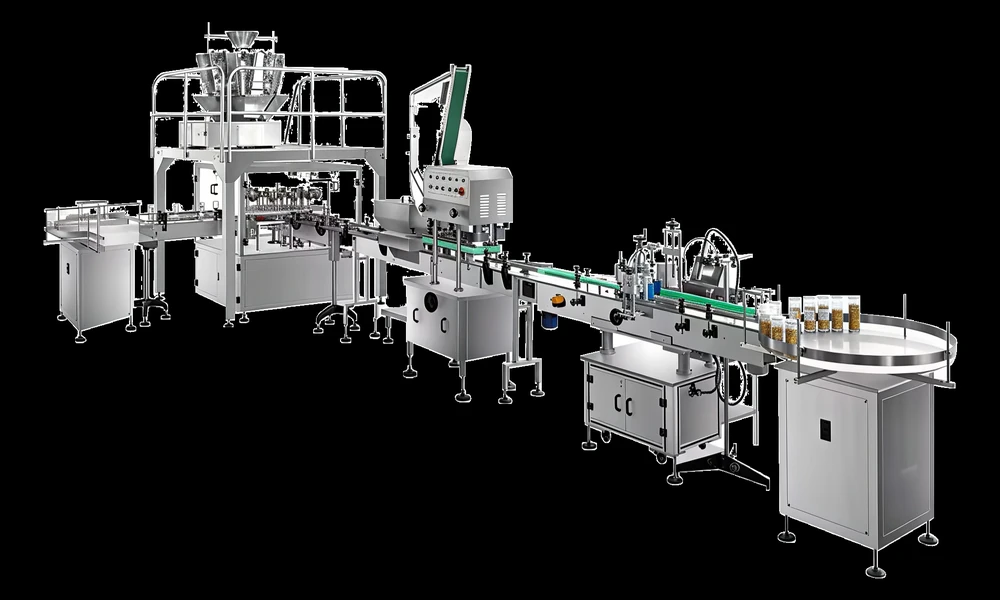
Can filling systems in Singapore serve a manufacturing sector that spans food and beverage, chemical, industrial lubricants, and speciality products. The common requirement across these applications is precision: accurate fill volumes that minimise product loss while meeting net content regulations, and the throughput speed that makes automated filling economically viable relative to manual operations.
What Can Filling Systems Do
A can filling system handles the complete filling process from empty can infeed to filled, sealed container outfeed. In a fully integrated line, the system includes:
- Can infeed and conveying: Empty cans are fed from a depalletiser or supply magazine and conveyed to the filling station at the rate required to maintain production throughput.
- Fill head array: Multiple fill heads operating in parallel fill several cans simultaneously, multiplying the effective throughput of the filling station.
- Filling mechanism: The specific filling principle – volumetric, gravimetric, or level-based – depends on the product characteristics and the accuracy requirements of the application.
- Seaming or lidding: Filled cans are immediately sealed at the seaming or lidding station to prevent contamination and product loss.
- Outfeed and secondary packaging: Sealed cans are conveyed to inspection, labelling, and secondary packaging stations downstream.
Can filling systems in Singapore are typically designed as configurable modular systems that can be specified for different can sizes, products, and production speeds, rather than as fixed machines that only accommodate a single application.
Accuracy Requirements
Fill accuracy in can packaging is a regulatory and commercial requirement simultaneously. Singapore Food Agency regulations on net content accuracy require that the stated net content of a packaged product is achieved within defined tolerances. Over-filling represents a direct financial loss in product given away. Under-filling risks regulatory non-compliance and consumer complaints.
Modern can filling systems achieve fill accuracy through several mechanisms:
Load cell integration measures the weight of each fill directly and allows the control system to adjust the fill quantity to compensate for product density variation between batches.
Feedback control loops monitor fill results and adjust the filling parameters dynamically to maintain accuracy as conditions change during the production run.
Calibration management allows operators to verify fill accuracy against reference measurements at defined intervals and to adjust calibration parameters without specialist technical intervention.
As Singapore’s Weights and Measures Office notes in its guidelines for packers, “Consistent fill accuracy is both a legal obligation and a critical element of the brand trust that consumers place in packaged goods.” Can filling system accuracy that meets this standard requires equipment correctly specified and calibrated for the specific product and container.
High Speed Production
The throughput capacity of a can filling system determines the production volume achievable in a given shift. High-speed can filling for beverage applications can achieve 300 to 1,000 cans per minute on multi-head rotary systems. Industrial can filling for chemical products at larger container sizes typically operates at lower speeds, from 10 to 100 units per minute depending on the container volume and the filling cycle time.
Speed is achieved through several design approaches:
- Multiple simultaneous fill heads that fill several containers in parallel rather than sequentially
- Rotary filling systems that move containers through the fill cycle on a rotating carousel rather than stopping and starting at a single station
- Product pre-pressurisation that maintains product supply pressure above the fill head to eliminate fill cycle delays from gravity-feed supply
Products and Applications
Can filling systems for Singapore’s diverse manufacturing sector serve applications including:
- Food and beverage canned products
- Aerosol products requiring pressurised filling
- Industrial lubricants and chemicals in tin cans
- Paint and coatings in cans
- Speciality chemical products in sealed metal containers
Each application has specific requirements for the filling mechanism, the materials in contact with the product, and the hygiene standards applicable to the filling environment.
Selecting a Can Filling System
The selection of the right can filling system for Singapore production depends on the product characteristics, the target production rate, the range of can sizes to be accommodated, and the integration requirements with upstream and downstream production line elements. Working with a specialist supplier with experience across can filling applications and an understanding of Singapore’s manufacturing regulatory environment ensures a system specification that performs reliably and meets all applicable requirements.